

The Runtime Is Free Now. The Harness Is the Business.
Microsoft built its flagship agent on OpenClaw and is pushing policy conformance upstream. If you build governed agents for healthcare, the market just moved to your thesis.

View all my published articles
Six months ago, Microsoft’s posture toward OpenClaw read as containment. According to multiple accounts, internal security guidance treated the open-source agent runtime as untrusted code that executed with persistent credentials, and Satya Nadella reportedly compared ungoverned deployments to a virus. Hold those two lines loosely, since they trace to secondary reporting rather than anything Microsoft published. The posture they describe was real either way. The official enterprise answer to “can I run this at work” was no.
Last week at Build, Microsoft shipped Scout, its first always-on agent, and built it on OpenClaw. Then it went further. It announced that it is contributing its policy conformance system directly upstream to the open project, so any organization running OpenClaw can validate its environment against security and compliance requirements and receive an audit-ready answer. That description comes from Microsoft’s own launch post, not from analyst spin.
The runtime Microsoft could not stop, it decided to standardize. That reversal is the story, and it carries a specific message for everyone building agents in regulated industries: the largest enterprise software company on earth just told the market that the agent is a commodity and the harness is the business.
What actually shipped
Scout is the first of a category Microsoft calls Autopilots: agents that run continuously rather than per-session, hold state, and operate across Teams, Outlook, OneDrive, and SharePoint. It is rolling out through the Frontier early-access program, desktop first. Under the hood is OpenClaw, the runtime Peter Steinberger assembled in late 2025, which went from weekend project to default substrate of the agent world in roughly six months.
Microsoft is not alone in the bet. Google shipped Gemini Spark on the same foundation days earlier, and Meta is reportedly close behind with Hatch. Three platform companies converging on one open runtime inside a single quarter is not sentiment. It is a verdict on where the value is not.
Why give away the good part
The New Stack published the sharpest read of the launch, and the analogy holds: this is Android again. Google made the base operating system a free common layer, and the money moved up the stack, into managed identity, device management, and the consoles enterprises actually pay for. The agent loop itself- read context, plan, call tools, write output- is heading the same direction. OpenClaw already does it well enough that Microsoft chose not to rebuild it.
Their illustration, which I will borrow and then transpose: picture an agent that reconciles invoices overnight. The reconciliation loop is solved; the open runtime handles it today. What stands between that agent and a production ledger is everything else. The company needs an identity it can name, a boundary that keeps the agent out of every system except accounts payable, and a record an auditor can reconstruct the next morning. The runtime supplies none of that. The layers above it do, and those layers are exactly what Microsoft kept: Agent 365, execution containment, the management plane.
What “policy conformance upstream” actually means
For the harness developers reading this, the substance matters more than the strategy. The control surface Microsoft describes has four parts. Agent identity, so every action has a named actor behind it. Scoped access, so the agent reaches only the resources and destinations the organization approved. Human approval gates on consequential actions, enforced before execution rather than logged after. And inline data protection, with sensitivity labels and loss-prevention policy applied at the moment of a write or send, not in a retrospective report. Conformance is the layer that checks a live deployment against those requirements and produces evidence of its passing.
Two implications follow if harnesses are your work.
First, the build-versus-buy line just moved. The bespoke validation scripts every serious OpenClaw shop has been writing by hand, the “is this deployment configured safely” code, become redundant as the upstream conformance layer matures. The durable work shifts to policy content: the baselines, the packs, the mappings from control to evidence that the conformance layer evaluates. Write policy, not plumbing.
Second, the timing is not subtle. The same week Scout launched, researchers disclosed five critical zero-days in OpenClaw’s allowlist identity resolution across a half dozen messaging surfaces. That is not an argument against the runtime. It is the argument for conformance. When the substrate moves this fast, you need a standard, repeatable way to prove your deployment is not the vulnerable configuration, and you need it on every release, not once a year during audit season.
The healthcare transposition
Now swap the invoice for a chart.
A patient agent that assembles a visit summary or drafts an amendment request after an AI scribe writes something wrong in a clinical note is not hard at the loop level. Tula does the first in about thirty seconds. What a health system needs before any agent touches PHI is the finance list with sharper teeth: an agent identity tied to an accountable person, access scoped to the minimum necessary record set, a human gate on anything that writes toward the legal record, and an audit trail that satisfies not just a CISO but a CMS surveyor or an OCR investigator. Patients exercising their right to amend under 164.526 deserve the same chain of evidence from their side of the portal.
Generic conformance gives you the substrate. It cannot tell you what counts as a sensitive action inside a clinical workflow, which evidence artifacts an auditor will actually accept, or how an amendment request must be tracked from submission to disposition. That is domain semantics, and it is the layer I have been calling the Fourth Tier: governed, domain-specific agents that sit above the runtime, the framework, and the generic harness. Microsoft just poured concrete under the first three tiers. The fourth is still open, and in healthcare it is still mostly empty.
Disclosure, because you should know where I sit: Tula, the open-source patient agent we released in May, runs on OpenClaw under an MIT license, and RealActivity’s compliance agents are built on the same runtime. When Microsoft puts platform engineering into the governance substrate of that runtime, the work compounds downstream, all the way to a patient agent running on a Medicare beneficiary’s laptop. I am long this thesis in the most literal way available.
Three moves
If you build agents in health and life sciences, three things follow.
Track the conformance work as it lands upstream, and build against it rather than beside it. Restructure your environment checks as policy packs the conformance layer can evaluate, so your controls inherit every improvement Microsoft ships instead of competing with them.
Stop spending innovation budget on substrate. Identity plumbing, containment, base audit logging: that work is being commoditized in public by companies with more engineers than you will ever hire. Your differentiation is policy content and the evidence model behind it, the parts that require knowing how a health system actually gets audited.
Pressure-test the phrase “audit-ready.” It means different things to a CISO, a HIPAA privacy officer, and a CMS surveyor. Map the conformance layer’s output to the artifacts your compliance team files today. Wherever there is a gap, that gap is your roadmap.
The harness was the bet
I have spent the past year making one argument: the agent was never the risk; the harness was. At Build, Microsoft made that argument for me, with a shipping product, an upstream contribution, and a 2026 roadmap priced around it. The runtime is free now. The harness never will be.
Vibes are becoming verifiable. This time it is on Redmond’s calendar too.
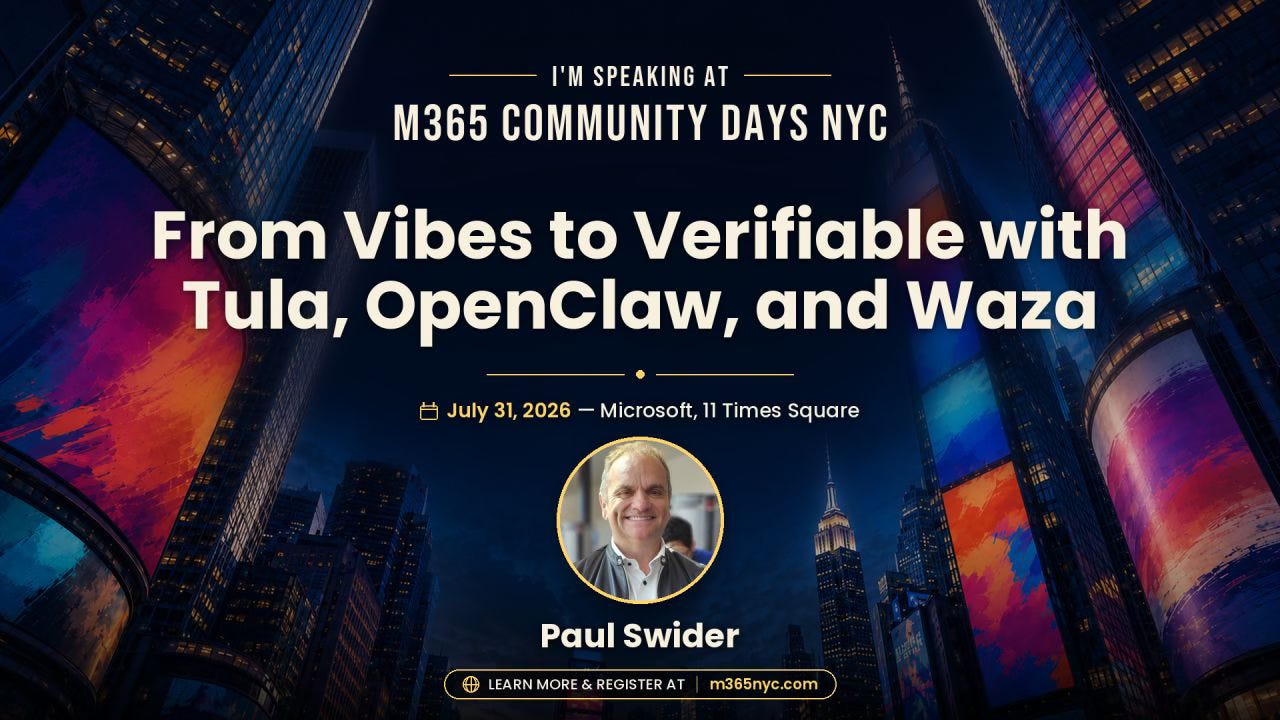
I will be going deeper on this on July 31 at M365 Community Days NYC, presenting “From Vibes to Verifiable” at Microsoft, 11 Times Square.
Sources
Microsoft 365 Blog, Scout launch announcement (June 2, 2026): https://www.microsoft.com/en-us/microsoft-365/blog/2026/06/02/introducing-microsoft-scout-your-always-on-personal-agent/
The New Stack’s analysis of the runtime-free, control-plane strategy: https://thenewstack.io/microsoft-scout-openclaw-runtime/
Reporting on Microsoft’s reversal and the Big Tech convergence on OpenClaw:
and https://thelettertwo.com/2026/06/07/openclaw-microsoft-google-meta-ai-agents
OpenClaw Weekly on the allowlist zero-day disclosures: https://www.bighatgroup.com/blog/openclaw-weekly-2026-06-08/

Paul J. Swider is CEO and Chief AI Officer at RealActivity, a Microsoft Partner specializing in mission-critical AI for healthcare systems. He has 30+ years in healthcare technology, has trained over 3,000 engineers across GE, IDX, and Microsoft, and is the founder of BOSHUG, the Boston Healthcare Cloud & AI Community spanning 50+ countries.