

Google Cloud's Agentic Moment in Healthcare
The question in 2026 is not what AI can do. It is what AI can be trusted to do

View all my published articles
I have been covering healthcare technology for 30 years. I have attended more HIMSS conferences than I can count. And I can tell you that what I witnessed this week at HIMSS26 in Las Vegas was different.
Not different in the way vendors always claim things are different. Different in a way you can measure. Different in a way that changes how patients experience care.
The centerpiece of that shift, for me, was a conversation I had with Aashima Gupta, Google Cloud’s Global Director of Healthcare Strategy and Solutions. She has been building Google Cloud’s healthcare business since 2016 and is one of the most influential voices in health IT. Sitting down with her at HIMSS was an honor, and the substance of what she shared stayed with me long after I left the room.
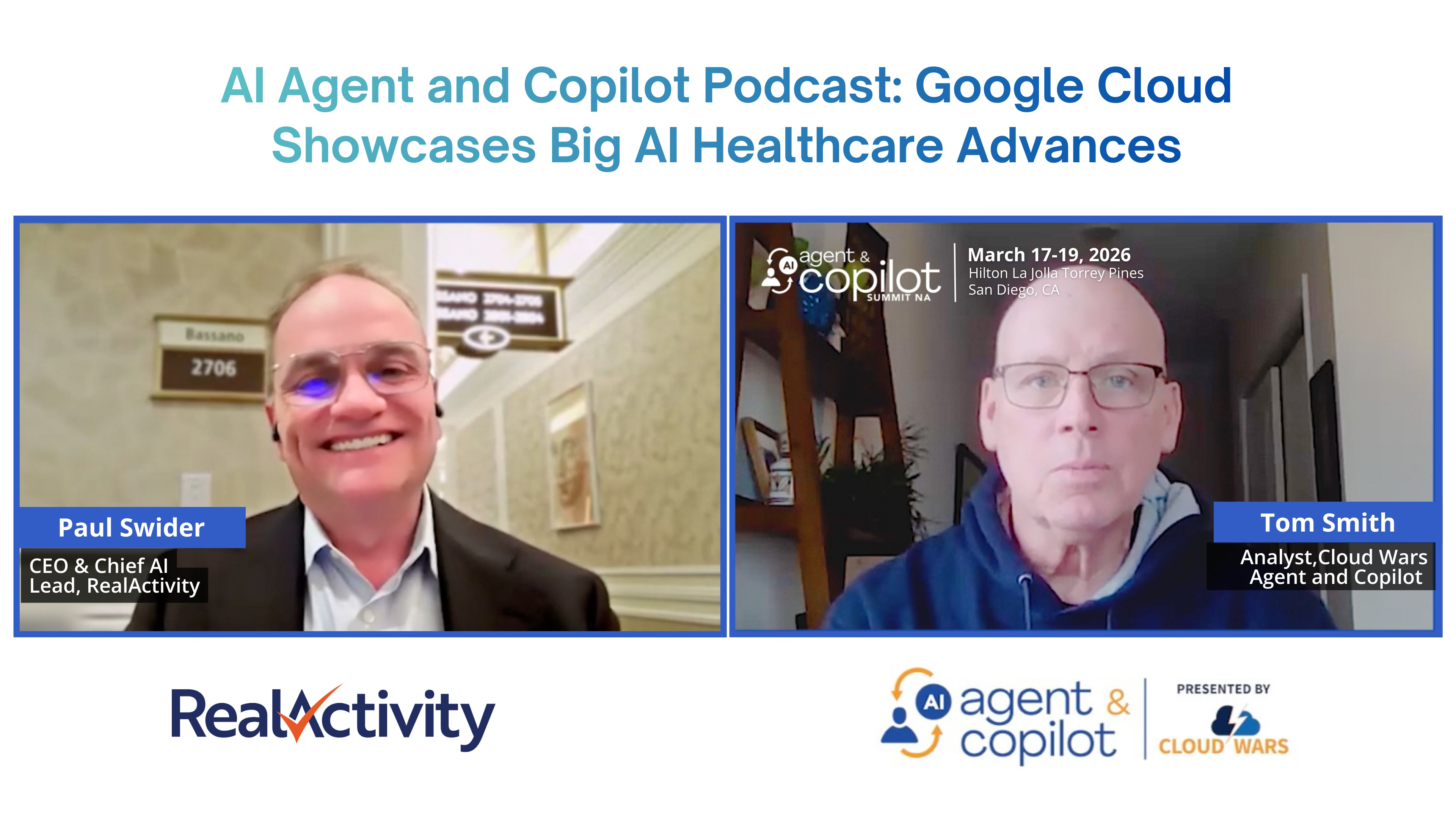
I also had the privilege of joining Tom Smith on the AI Agent and Copilot Podcast for Cloud Wars to break down what I learned from that conversation and from the HIMSS floor. You can watch the full episode here.
The Agentic Moment
Aashima put it directly. This is an “agentic moment” for healthcare.
That language matters. She was not describing a product update or a marketing campaign. She was naming a threshold. Healthcare AI has moved from suggesting to acting. From chatbots responding to prompts to agents that reason, orchestrate, and execute multi-step workflows across entire systems.
In her official blog post ahead of HIMSS26, she wrote that healthcare is moving beyond static digital records into what she called the “agentic healthcare era.” A fundamental shift from point-and-click software to anticipatory care. She painted a picture I found compelling. Imagine a world where clinical insights find the doctor at the exact moment of care, letting the stethoscope, not the screen, remain the center of the exam room.
That is not a five-year-out vision. That is the direction being built right now.
Five Partnerships. Five Domains. All in Production.
What made Google Cloud’s HIMSS26 presence stand out was the scope. They did not show up with one announcement. They brought five, and each one covered a different domain of healthcare.
CVS Health launched Health100, a new tech-enabled subsidiary built on Google Cloud’s Gemini models. It is positioned as an AI-native consumer engagement platform with an open ecosystem approach, designed to serve patients regardless of pharmacy, insurer, or provider. Thomas Kurian, CEO of Google Cloud, called it the future of agentic, AI-powered health care that enhances human touch and eliminates complexity. This is part of CVS’s broader $20 billion technology commitment and the most ambitious consumer-facing healthcare AI deployment I have seen.
Highmark Health’s generative AI assistant Sidekick grew from 1 million to over 6 million prompts across 74 active use cases in just over a year, delivering an estimated $27.9 million in AI-enabled value. They announced new capabilities including a synthetic audience feature and an IRB protocol builder for Allegheny Health Network. Richard Clarke, their Chief Data and Analytics Officer, signaled the next chapter is bringing multi-agent support to employees.
Waystar expanded its Google Cloud partnership to accelerate agentic AI for the autonomous revenue cycle. Their AltitudeAI platform has prevented more than $15 billion in denied claims in less than a year and reduced time spent on denial workflows by 90 percent. Waystar connects over 1 million providers processing 7.5 billion annual transactions, roughly 60 percent of the US patient population.
Humana launched Agent Assist, built on Google Cloud’s Vertex AI and Gemini. The tool supports over 20,000 member advocates handling up to 80 million calls annually. It summarizes conversations in real time, anticipates member needs, and surfaces relevant benefit details while keeping humans accountable for final decisions.
Quest Diagnostics introduced Quest AI Companion, an AI-powered chat feature in the free MyQuest app and portal. Powered by Google’s Gemini models, it analyzes up to five years of an individual’s lab data, provides plain-language explanations, and helps patients compose questions for their healthcare providers. It is HIPAA-compliant and operates entirely within the MyQuest environment.
These are not pilot programs. These are production systems operating at enterprise scale.
The Example That Brought It Home
During my conversation with Aashima, the example that hit hardest was HCA Healthcare. 190 hospitals. 60,000 nurse handoffs every single day. At the end of a 12-hour shift, a nurse sits down to prepare the handoff for the incoming nurse. That is where mistakes happen, when people are tired and rushing.
Google is supporting that handoff with AI. Even saving five minutes per handoff, multiplied by 60,000, returns 300,000 minutes a day to patient care.
But what Aashima said next is what really stayed with me. Every job has a chore and a purpose. Healthcare workers are in it for the healing and the empathy. AI is taking away the chore so they can do the meaningful work.
That reframes the entire AI conversation. Not replacing workers. Returning purpose to the workforce. I discussed this at length on the AI Agent and Copilot Podcast because it is the kind of framing that healthcare leaders need to hear. The resistance to AI in clinical settings often comes from a fear of replacement. This framing dismantles that fear.
Patient Agency and the Trust Question
I pushed Aashima on patient agency. This is my long-standing conviction and something I am deeply passionate about. The real power of AI in healthcare is not just making organizations more efficient. It is returning control to the patient.
Quest AI Companion was the example I focused on. For the first time, a patient can chat with five years of their own lab results through an AI agent. Personalized to their age, ethnicity, and history. That feels like a threshold moment.
I asked her directly. Do you see a future where patients bring their own data to their own agent of choice?
Her answer was one of the best I have gotten on this topic. The question in 2026 is not what AI can do. The question is what AI can be trusted to do.
She introduced the concept of “enterprise truth,” the idea that agents must be grounded in authoritative clinical sources. Quest has the protocols, the global lab standards, the knowledge base. When you get a response from their AI companion, it is grounded in that truth. That is different from throwing your lab results into a general-purpose AI and hoping for the best.
She then connected this to their ASCO partnership, where 50,000 oncologists worldwide now have access to an agent grounded in gold-standard cancer treatment guidelines. An oncologist in California, New York, or India gets the same authoritative guidance. That is the promise of trusted AI at global scale.
Interoperability Is the Unlock
One of the things I emphasized on the Cloud Wars podcast is that interoperability will determine whether the agentic era succeeds or fragments.
Aashima built her career on this. From the first Kaiser Permanente API to leading interoperability at Apigee to now. She made a point that resonated with me deeply. If we do not get agent-to-agent interoperability standards right, we are going to create a bigger mess than the data silos we have been trying to fix for a decade.
Google is supporting open standards like A2A, their Agent-to-Agent protocol, which was originally launched in April 2025 and donated to the Linux Foundation. It standardizes how AI agents discover and communicate with each other regardless of framework or vendor. Notably, athenahealth unveiled a Model Context Protocol server at HIMSS26 as well, the complementary protocol that handles agent-to-tool communication. The infrastructure for multi-agent healthcare systems is being laid right now.
Three Takeaways for Healthcare Leaders
After this conversation, after walking the HIMSS floor, and after breaking it all down on the AI Agent and Copilot Podcast, three things are clear to me.
First, the agentic era is real and it is here. HCA is running 60,000 handoffs. Highmark has 74 live use cases producing $27.9 million in measurable value. Humana is deploying across 20,000 advocates. Waystar has prevented $15 billion in denied claims. These are production systems, not pilots.
Second, enterprise truth is table stakes. Google Cloud’s position is clear. AI agents in healthcare must be grounded in verified, authoritative data. Not general-purpose guessing. The governance question is now inseparable from the AI question.
Third, the patient needs to be in this conversation. We are building incredible agent infrastructure for organizations. But the patient is still on the receiving end of everyone else’s agent. Quest AI Companion is a first step. I want to see that door open wider. And to Aashima’s credit, she engaged on that directly rather than deflecting.
If you are a healthcare leader, the question is not whether to adopt agentic AI. It is whether your organization is ready to govern it, trust it, and eventually put it in the hands of your patients.
Listen to the Full Conversation
I joined Tom Smith on the AI Agent and Copilot Podcast to walk through everything I learned from my conversation with Aashima Gupta and from the HIMSS26 floor. We covered the agentic moment, real-world deployment examples, patient agency, and where this is all heading over the next 12 months.
Listen here AI Agent and Copilot Podcast, Google Cloud Showcases Big AI Healthcare Advances
References
Google Cloud Blog. "Helping Healthcare Move from Data to Agentic Action." March 5, 2026.
TechTarget. "AI ROI, Agentic Innovation in Spotlight as HIMSS Approaches." March 2026.
AI Agent and Copilot Podcast. “Google Cloud Showcases Big AI Healthcare Advances.” March 13, 2026.
Google Cloud Blog. "What It Takes to Get Your Team Ready for the Agentic Era." January 30, 2026.
HIT Consultant. “HIMSS26 Pre-Day Recap: How Agentic AI is Taking Over Healthcare IT.” March 9, 2026.
Paul J. Swider is CEO & Chief AI Officer at RealActivity, a Microsoft Partner specializing in mission-critical AI for healthcare systems. He has 30+ years in healthcare technology, has trained over 3,000 engineers across GE, IDX, and Microsoft, and is the founder of BOSHUG, the Boston Healthcare Cloud & AI Community spanning 50+ countries.