


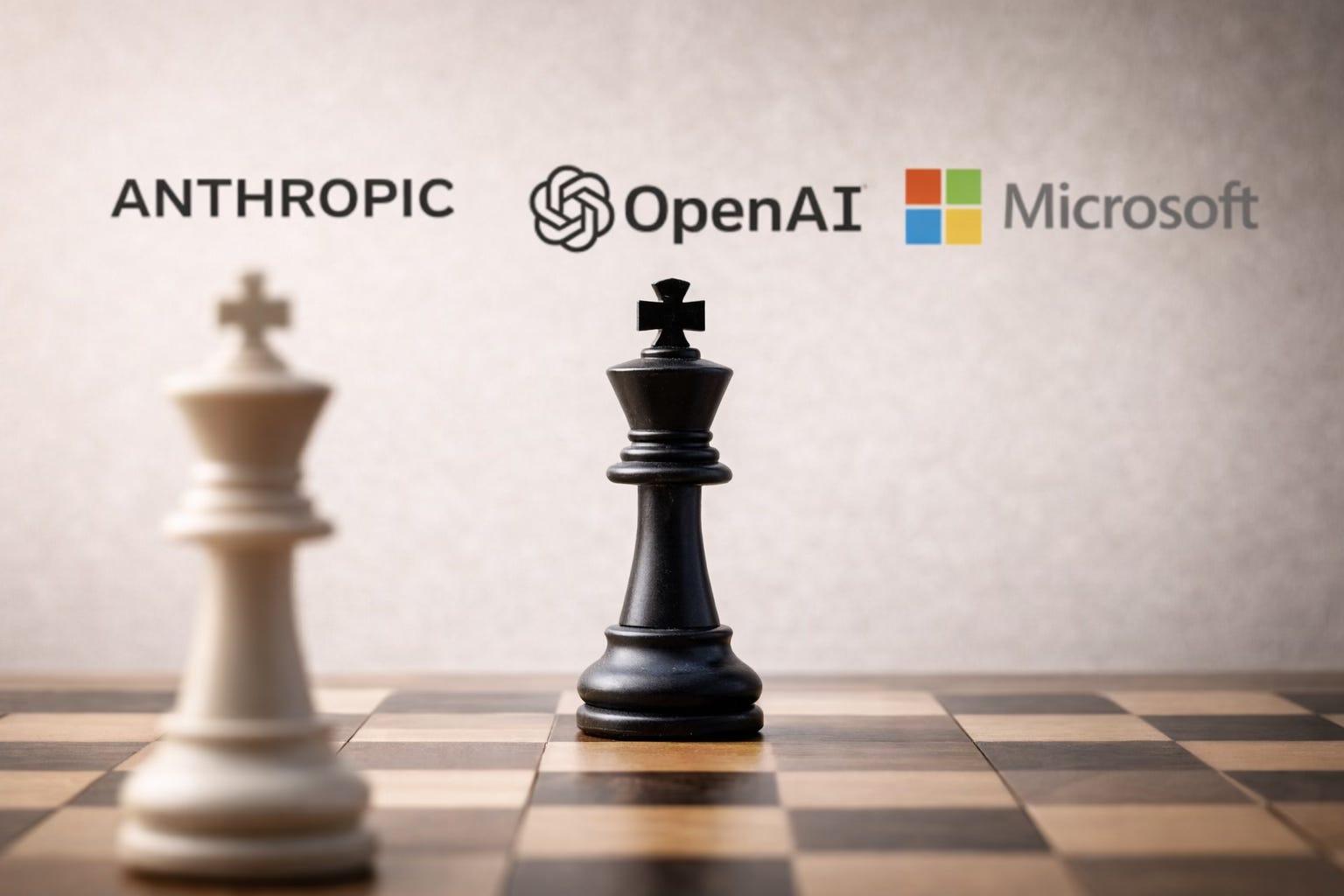
The real AI war isn't about models anymore. It's about who controls the operating system for digital labor.
If you're still watching the AI race as a contest between Claude, GPT, and Gemini, you're watching the wrong game.
The real battle just moved up the stack.
OpenClaw. Anthropic's CoWork. OpenAI's emerging agent initiatives. Microsoft's GitHub Copilot API push. These aren't incremental product updates, they're land grabs for the most consequential layer in enterprise AI, the agent runtime.
And here's what most people are missing. Cowork and OpenClaw occupy the same conceptual space. Both represent horizontal, standalone agent platforms built on top of powerful code-capable models. Both signal the rise of a new category, general-purpose digital coworkers, not narrow copilots that autocomplete your email.
This is the moment the industry shifts from AI as assistant to AI as labor infrastructure.
The New Stack That Matters
Forget the model benchmarks for a second. Here's the stack that will define enterprise AI for the next decade:
Foundation Model → Agent Runtime → Enterprise Workflow Platform
The foundation model is the engine. The agent runtime is the operating system. The enterprise workflow platform is where work actually happens.
Whoever defines the standard for agent execution, governance, identity, tool access, observability, compliance, will shape how digital labor operates inside organizations. Full stop.
We've seen this pattern before. It doesn't matter if you have the best CPU if someone else owns the OS. And right now, three very different strategies are competing to become that OS.
Three Strategies, One Prize
Anthropic's CoWork reflects a safety-first enterprise positioning. It's Claude-native, deeply opinionated about guardrails, and designed for organizations that want agentic AI without the existential risk conversations at their board meetings. For healthcare systems, my world, this matters enormously. When your agent is touching clinical workflows, safety isn't a feature. It's the product.
OpenAI's alignment with OpenClaw signals serious investment in open agent infrastructure. This is a different bet: that the orchestration layer should be model-agnostic, interoperable, and community-driven. If OpenClaw evolves into a true open runtime, it could reduce model lock-in and shift power away from any single model provider. That's a strategic gift to enterprises, and a potential threat to everyone selling vertical integration.
Microsoft's GitHub Copilot API push is the one healthcare CIOs should be watching most carefully. Microsoft isn't just making Copilot better, they're transforming it from a productivity feature into programmable infrastructure embedded across Azure, GitHub, Entra ID, and Microsoft 365. With that distribution advantage, Microsoft can embed agents directly into enterprise workflows where identity, compliance, and data governance already live. For health systems already deep in the Microsoft ecosystem, this is the path of least resistance to agentic AI.
The Strategic Fork: Open vs. Model-Native
This is the question that will define the next chapter:
Will agent platforms be model-agnostic and open, letting enterprises swap foundation models the way you swap databases? Or will they be vertically integrated, Claude-only ecosystems, GPT-only ecosystems, where the model and the runtime are inseparable?
The answer will determine whether the future looks like the open web or the app store.
OpenClaw leans toward the open model. Cowork leans toward the integrated model. Microsoft, characteristically, is trying to play both sides, open enough to attract developers, integrated enough to lock in enterprises.
For healthcare organizations evaluating these platforms, this isn't an abstract architectural debate. It's a procurement decision with decade-long implications. Choose the wrong side of this fork and you're either locked into a single vendor's roadmap or managing a complexity explosion of interoperable components with no single throat to choke.
What This Means for Healthcare
When strong reasoning models combine with tool use, memory, and workflow control, AI shifts from assistant to autonomous executor. In healthcare, that means agents that don't just summarize clinical notes, they execute multi-step compliance workflows, coordinate across EHR systems, manage FTE tracking, and flag regulatory gaps before they become audit findings.
This isn't theoretical. This is what we're building at RealActivity right now, mission-critical AI implementations for health systems that need agents operating inside their compliance boundaries, not outside them.
The organizations that move early to understand this agent runtime layer, not just the model layer, will have a structural advantage in how they deploy, govern, and scale AI across clinical and administrative operations.
The Bottom Line
The AI model wars made great headlines. The agent runtime wars will make great businesses.
The winner won't necessarily be the best model. It will be the platform that becomes the trusted operating system for enterprise AI agents, the one that solves identity, governance, tool access, observability, and compliance at the orchestration layer.
For healthcare, where trust is the currency, that distinction is everything.
References
Anthropic. "Introducing Cowork." Claude Blog, January 12, 2026.
Ropek, Lucas. "Anthropic Brings Agentic Plug-ins to Cowork." TechCrunch, January 30, 2026.
"What Is OpenClaw: Autonomous AI Agent Framework Explained (2026 Guide)." AI Cloud IT, February 2026.
Wiggers, Kyle. "OpenAI's Acquisition of OpenClaw Signals the Beginning of the End of the ChatGPT Era." VentureBeat, February 15, 2026.
Microsoft Community Hub. "Building Agents with GitHub Copilot SDK: A Practical Guide." Microsoft Tech Community, January 22, 2026.
Paul engages with this space daily as CEO & Chief AI Officer at RealActivity, a Boston-based Microsoft partner specializing in mission-critical AI for health systems, and as a healthcare AI analyst for Cloud Wars. He founded the Boston Healthcare Cloud & AI Community (BOSHUG), a non-profit spanning 50+ countries.